
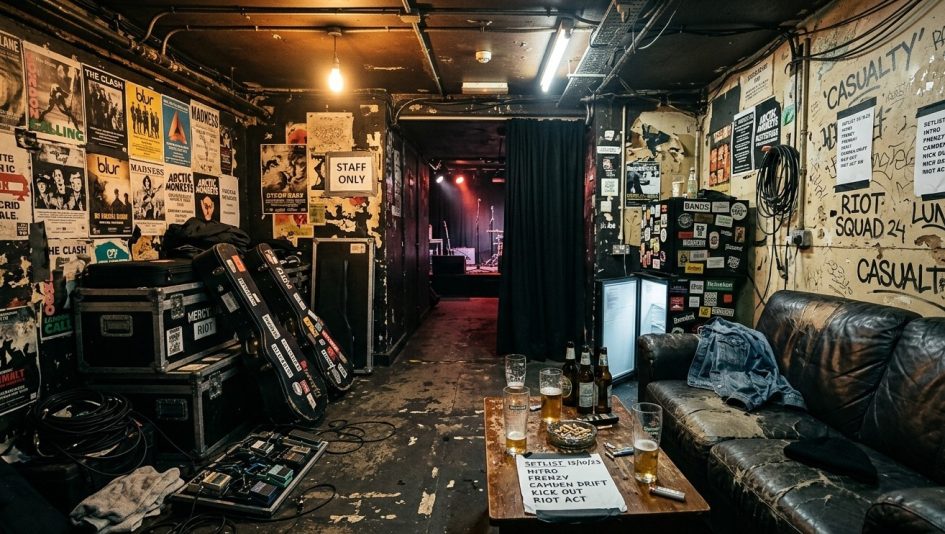
There is a particular kind of magic that happens the moment the house lights drop at a live music venue. The crowd shifts forward, the air thickens with anticipation, and for the next two hours, everyone in the room collectively agrees to forget that they are standing in a building that has been occupied by several hundred sweaty strangers since half past seven. Beautiful, really.
Ten metres behind the stage door, however, the magic has a somewhat different texture. Backstage at a busy London live music venue – on a Saturday night, with a full touring party in residence and a rider that has been enthusiastically received – is one of those environments that requires a particular kind of professional composure. The sort you develop over time, ideally alongside a robust appreciation for industrial-grade disinfectant.
Backstage sanitation at London venues is one of the most consistently underestimated disciplines in the live events industry. Here is what it actually involves, what the law expects, and why getting it right is considerably more involved than a quick hoover between soundcheck and doors.
What “Backstage” Actually Means in a London Live Music Venue
From the O2 Arena to the 100 Club – Why No Two Venues Are the Same
Before we can talk sensibly about sanitation standards, we need to establish something that anyone who has worked across multiple London venues understands immediately: “backstage” is not a coherent, standardised thing. It is a catch-all term that covers an enormous range of environments, and treating them as though they follow the same operational logic is the first mistake a cleaning contractor can make.
At the O2 Arena, backstage is essentially a small city. You have production corridors wide enough for full equipment trucks, dedicated catering suites, multiple dressing room wings, laundry facilities, and enough square footage to get genuinely, embarrassingly lost in on your first visit. The sanitation operation required there is a structured, multi-team undertaking with its own internal logistics.
At a 200-capacity venue in Camden – and there are several where the backstage consists of a single room that functions simultaneously as green room, dressing room, catering space, and storage for whatever the previous band left behind three weeks ago – you are working with an entirely different proposition. The fundamentals are the same. The spatial reality is absolutely not.
Effective backstage sanitation planning starts with an honest assessment of the actual space in front of you. A generic checklist imported from a larger venue’s operations manual, applied without adaptation to a Victorian pub basement in Kentish Town, is not a cleaning standard. It is a document that makes someone feel better about the situation without materially improving it.
The Legal Baseline – What Environmental Health Inspectors Actually Expect
Food Safety, Wet Areas, and the Paperwork That Keeps Your Licence on the Wall
Here is something that surprises a notable number of venue operators when it is pointed out to them: Environmental Health Officers do go backstage. They are not confined to the front-of-house kitchen and the public toilets. If there is food preparation happening in a rider catering area, wet surfaces that require compliance signage, or waste being generated and stored in a way that creates health risks, the backstage is very much within scope. The assumption that it is somehow off-limits is a comfortable fiction that has caused more than a few venues a genuinely bad afternoon.
The legal framework covering backstage sanitation in London venues draws primarily from food hygiene regulations, the Health and Safety at Work Act, and COSHH requirements governing the storage and use of cleaning chemicals. In practical terms, this means that any area where food is being handled – including rider prep, buffet catering, and shared hospitality – must meet the same basic food safety standards as a commercial kitchen, regardless of how informally it operates.
Wet areas, including shared shower facilities and backstage toilet provisions, require appropriate ventilation, anti-slip compliance, and a cleaning frequency that is documented and demonstrably followed. That last word is the one that matters most in an inspection context. Cleaning schedules, sign-off logs, and COSHH records are not bureaucratic padding. They are the evidence base that demonstrates a venue takes its obligations seriously – and the thing that keeps the premises licence safely on the wall rather than under review.
Dressing Rooms, Riders, and the Sanitation Realities Nobody Puts in the Contract
Biohazard Situations, Post-Show Cleanup, and Cleaning Around a Technical Crew
Let us be straightforward about dressing rooms, because the industry sometimes talks around this particular topic with a delicacy it does not entirely deserve. A dressing room that has hosted a touring band through a two-hour headline show, with a rider that included perishables, alcohol, and a degree of enthusiastic occupation, is going to require more than a perfunctory wipe-down before the next act arrives. Occasionally, it is going to require a response that falls firmly into biohazard territory. That is not a criticism of musicians. It is simply an accurate description of what happens when human beings experience adrenaline, exertion, and hospitality in an enclosed space with limited ventilation.
Professional cleaning crews working backstage need established protocols for post-show dressing room remediation that cover: removal and appropriate disposal of all food and drink waste including spillages, disinfection of all contact surfaces, floor cleaning to a standard that accounts for whatever has been on it, and assessment of whether anything requires specialist treatment before the room is handed back for the next occupancy.
The additional complication – and this is where scheduling discipline becomes critical – is that dressing room cleaning after a headline show rarely happens in a vacuum. Technical crews are simultaneously striking the stage. Tour managers are coordinating load-out. Merchandise staff are packing down. The backstage corridor at eleven o’clock on a Saturday night is not a serene environment conducive to unhurried professional cleaning. Establishing a clear sequence that respects the production load-out timeline while ensuring the cleaning work is actually completed to standard, rather than rushed into invisibility, is a skill that takes genuine experience to develop.
Green Rooms, Catering Areas, and the Cross-Contamination Risks Most Venues Overlook
Why Food Safety Standards Apply Backstage Just as Much as They Do in the Kitchen
The green room buffet is a staple of the live music experience that has featured in enough tour documentaries and behind-the-scenes footage to have become almost mythologised. What those documentaries tend not to linger on is the cross-contamination risk profile of a shared buffet-style hospitality setup in a warm, enclosed backstage space where the food has been sitting out since the production meeting at four in the afternoon and it is now approaching midnight.
Backstage catering areas present a specific set of food safety challenges that professional cleaners need to understand and account for. Shared surfaces used for food preparation and service require disinfection between uses, not simply a wipe with whatever cloth happens to be nearby. Food waste must be removed promptly and stored correctly – not left in an open bin in a warm room until the load-out is complete. Temperature management for perishable rider items is the responsibility of whoever is overseeing the catering, but the cleaning team’s waste management practices directly affect whether that environment remains hygienic across the full duration of an event.
The particular hazard that catches backstage spaces out more frequently than any other is the assumption that because an area is not the official kitchen, normal kitchen hygiene standards do not fully apply. They do. The bacteria causing food poisoning after a touring party’s catered dinner are not consulting the venue’s organisational chart before deciding where to proliferate.
Scheduling the Invisible Work – How Professional Venues Build Sanitation Into the Event Timeline
The Window Between Doors and Showtime That Most Venues Waste
The single biggest practical failure in backstage sanitation at London live music venues is not a lack of knowledge about the relevant standards. It is a failure to schedule the work properly against the event timeline – which means that even venues with entirely correct intentions end up with cleaning that is either rushed, incomplete, or happening at the wrong moment relative to everything else going on around it.
A professional cleaning operation working a live music venue maps its activity against the full event day. The pre-show window – from venue access through to doors opening – is the primary opportunity for thorough dressing room preparation, green room setup to food hygiene standard, and a full sanitation pass of all backstage wet areas. This window is finite, frequently compressed by late production arrivals or extended soundchecks, and entirely wasted if no one has thought in advance about when the cleaning team needs to be on site and what they need to complete before the first person walks through the stage door.
Mid-show maintenance – a tactical pass through backstage areas during the support act or the headline’s set – addresses the accumulation that builds across an event evening and prevents the post-show clean-up from becoming an overwhelming undertaking. The post-show sequence itself needs to be agreed with production in advance, with clear handover points that allow cleaning to begin without obstructing load-out.
None of this is complicated in principle. All of it requires planning that happens before the show, not improvisation that happens after it.
No Applause, No Encore, No Problem
The Bit That Earns the Five-Star Hygiene Rating
There is an old line in this industry that the best cleaning job is the one nobody notices. Nobody walks into a dressing room that has been properly prepared between acts and thinks, “exceptional surface disinfection in here.” They just get on with their pre-show routine, entirely unaware that the space they are occupying has been professionally remediated since the previous band vacated it two hours ago. The work is invisible by design – and that invisibility is, paradoxically, the clearest possible indicator that it has been done correctly.
Backstage sanitation at London’s live music venues does not attract headlines, does not feature in reviews, and will never be the subject of an appreciative rider note. What it does, consistently and without fanfare, is protect the health of the people working in those spaces, keep venues on the right side of their legal obligations, and ensure that the infrastructure supporting the actual performance – the bit everyone came for – functions as it should.
No applause. No encore. Exactly as it should be.