
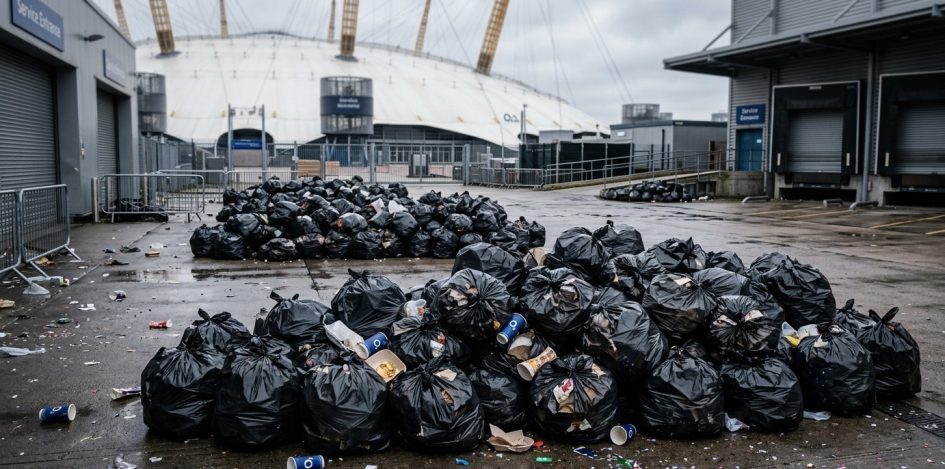
The O2 Arena holds 20,000 people. On a big night – your Adeles, your Coldplays, your sold-out comeback tours that had the internet in collective meltdown for approximately forty-five minutes when the tickets dropped – every single one of those seats is occupied. Each of those 20,000 people has, over the course of an evening, consumed at least one drink, quite possibly a £14 hot dog, and generated a quantity of waste that, when you multiply it across the full house, produces a post-event rubbish removal challenge of genuinely impressive proportions.
The O2 is not just one of the busiest entertainment venues in the United Kingdom. By ticket sales, it regularly ranks as one of the busiest music arenas on the planet. Which means that when the last chord fades and the crowd files back out through the dome towards North Greenwich station, what gets left behind is not a minor tidying job. It is a structured, multi-phase professional operation that demands preparation, discipline, and a checklist that has been thought through properly before a single bin bag gets opened.
Here is that checklist – drawn from the operational realities of large-scale arena cleaning and structured in the sequence that professional crews actually follow.
Before Anyone Picks Anything Up: The Pre-Clean Assessment
Why the First Thirty Minutes After Crowd-Out Determine Everything That Follows
There is an overwhelming temptation, when you walk into a 20,000-capacity arena immediately after a show, to simply start cleaning. Resist it. The most valuable thirty minutes in any large-scale post-event rubbish removal operation is the assessment phase – the structured walk of the full venue that happens before the crew deploys in earnest.
The pre-clean assessment covers several non-negotiables. Identify any hazardous material requiring specialist handling before standard crew members encounter it – broken glass concentrations, biohazard situations, or anything that has made its way somewhere it structurally should not be. Note where the heaviest waste accumulations are so that crew deployment can be weighted accordingly rather than distributed evenly across the space. Check that all waste removal routes – service corridors, goods lifts, external loading access – are clear and operational. Confirm skip and waste vehicle positioning outside the venue.
Document the pre-clean condition. Photographs before the crew starts work are not paranoia – they are professional due diligence that matters enormously if a damage or liability question arises later. Get the assessment done properly and the rest of the operation flows. Skip it because you are keen to crack on and you will spend the next three hours solving problems that a half-hour walk would have prevented.
The Seating Bowl: Row-by-Row Clearance Done Properly
Cups, Confetti, and the Particular Menace of the Inflatable Foam Hand
The seating bowl is, by surface area and sheer volume of waste generated, the dominant challenge of any arena post-event clean. At the O2, that means 20,000 seat positions across multiple tiers, every one of which has been occupied by a person who spent the evening putting things down, leaving things behind, and – depending on the act – participating in audience interactions that generated their own specific waste profile. Confetti cannons, by the way, are the glitter of the live events world. They look magnificent. They are still turning up in seat crevices six months later.
The checklist for seating bowl clearance runs as follows. Work tier by tier, top to bottom, in a consistent direction that moves waste towards the central collection points rather than redistributing it across already-cleared sections. Every row gets a full sweep – under seats as well as on them, because cups have an almost gravitational tendency to migrate towards the floor the moment a person stands up. Consolidate waste into bags at the end of each section block rather than carrying individual items to a central point, which wastes time and creates collision hazards in narrow row access points.
Seat condition is assessed as clearance progresses, not as a separate exercise afterwards. Any damage, spillage requiring specialist treatment, or seat mechanism issue gets flagged during the sweep – not discovered during the next day’s pre-show inspection when the timeline for addressing it is considerably less comfortable.
Concourses, Bars, and Concession Areas: The Grease-and-Glass Zone
High-Volume Footfall, High-Volume Waste, and Surfaces That Know It
If the seating bowl is the volume challenge of an arena post-event clean, the concourses and food and beverage areas are the intensity challenge. These spaces have absorbed hours of high-footfall traffic, sustained food and drink service, and the particular attentions of 20,000 people operating in the relaxed, cheerful, and occasionally spectacularly careless way that people do when they are at a gig and the evening has gone well.
Bar surfaces, concession counters, and the surrounding floor areas require a sequenced approach that respects the difference between waste removal and cleaning. Waste comes out first – consolidation of cups, packaging, food waste, and service debris before any surface cleaning begins. Attempting to clean surfaces with waste still present is one of those things that looks like progress while actually extending the total time the job takes. It is the arena cleaning equivalent of tidying around a mess rather than moving it.
The checklist for concourse areas: waste consolidation and removal from all surface areas and floor zones; wet waste and food debris bagged and removed before any mopping begins; bar and concession surfaces cleared of all service equipment that is not fixed; spillage areas assessed for slip risk and treated accordingly; waste bins emptied and relined ready for the next event. Floor cleaning in these areas – given the combination of spilt drinks, food debris, and the cumulative footprint of an audience in various states of festival spirit – is a separate phase that follows waste removal rather than running concurrently with it.
Toilets and Welfare Facilities: The Section Everyone Is Delighted to Skip Past in the Checklist
And Why Doing So Is an Excellent Way to Fail an Environmental Health Inspection
Nobody has ever said “the bit I am really looking forward to today is the post-show toilet clean.” It is not a sentence that exists. It is, however, a section of the checklist that demands the same professional rigour as any other part of the operation – arguably more, given that welfare facilities are among the first areas an Environmental Health Officer moves to if the visit is anything other than entirely routine.
Post-event toilet clearance at a venue the size of the O2 covers: removal of all waste from bins, sanitary disposal units, and floor areas; assessment and reporting of any blockages, damage, or infrastructure issues; surface disinfection of all contact points – door handles and push plates included, not just the obvious surfaces; replenishment of consumables if next-day restocking is within the crew’s scope; and a final condition check documented and signed off before the area is handed back.
The documentation point is worth restating here, because it applies across the full checklist and not just the welfare facilities. Sign-off at each phase of the operation is not paperwork for paperwork’s sake. It is the evidence trail that protects the cleaning contractor, protects the venue, and demonstrates a standard of professional accountability that separates a well-run operation from one that is hoping nobody looks too closely.
Backstage, Production Areas, and the Bits the Audience Never Knew Existed
Dressing Rooms, Load-Out Corridors, and Whatever the Touring Party Left Behind
The audience has gone home. The artist is, with any luck, back at a hotel somewhere in central London, blissfully unaware that their dressing room currently looks like the aftermath of a particularly enthusiastic birthday party in a skip. The production crew is in the middle of a load-out that will take several more hours and involves a quantity of flight cases that appears to increase rather than decrease as the night goes on. And somewhere in the middle of all of this, the post-event cleaning crew needs to work through the backstage areas without causing a logistical incident.
The backstage checklist runs in coordination with production load-out, not in competition with it. Dressing rooms become available as the touring party clears them – typically in a sequence that the tour manager can indicate in advance if the relationship between venue, production, and cleaning contractor is a professional one. Each room gets a full waste removal pass: all food and drink waste out, rider debris consolidated and bagged, any perishables that cannot be donated disposed of appropriately.
Production corridors and load-out routes are kept clear throughout. Waste removal from these areas is timed around vehicle movements, not squeezed in around them. The last thing anyone needs at one in the morning, when a crew of twelve is trying to move a forty-foot truck’s worth of equipment through a service corridor, is a cleaning operative and a fully loaded waste trolley arriving from the opposite direction.
The Final Sweep: Closing the Job Properly
Because “Probably Fine” Is Not a Professional Standard
Every post-event rubbish removal operation at a large venue ends the same way – or should. A final walk of the full site, conducted by the crew supervisor, against the checklist. Not a casual glance. A structured check of every zone that has been cleared, confirming that the standard has been met and that nothing has been missed in the organised chaos of a large-scale post-show clean-up.
The final sweep catches the things that fall between phases: the overlooked section of upper tier seating, the concourse bin that was somehow missed in the consolidation run, the backstage corridor that was cleared and then acquired a fresh deposit of production debris after the crew moved on. These are not failures of competence. They are the inevitable consequence of working a complex, multi-zone environment with a lot of moving parts – and the final sweep is the professional mechanism that catches them before they become someone else’s unpleasant discovery the following morning.
Sign off the job. Document the final condition. Hand it back in the state it needs to be in. The O2 has another show in forty-eight hours, and the whole beautiful, exhausting process begins again.